China Top 10 Brick Fireplace With Pizza Oven Suppliers?
Demand for outdoor cooking spaces is expanding beyond basic grills. Allied Market Research valued the global outdoor kitchen market at approximately USD 19.5 billion in 2022. Its report projects the market to reach about USD 40.8 billion by 2032. These figures include broader outdoor kitchens, not only masonry ovens. That distinction matters.
A brick fireplace with pizza oven combines heating, cooking, and architectural character. It can anchor a garden terrace with a stone hearth, arched opening, and visible flame. However, appearance alone proves little. Refractory brick quality, insulation thickness, dome geometry, curing instructions, and chimney design strongly influence performance. Grand View Research also identifies outdoor living upgrades and premium residential construction as important market drivers. Buyers therefore need more than attractive photographs.
Alan Scott, a respected wood-fired oven builder, described the oven as “the heart of the kitchen.” His observation remains practical. Heat retention, airflow, and usability determine whether that heart performs consistently. This guide examines China’s top 10 brick fireplace with pizza oven suppliers through those criteria. It considers manufacturing experience, material transparency, export capability, customization, quality control, and after-sales support. Product claims should be checked against test records and installation guidance. Some supplier information is incomplete, and that limitation deserves acknowledgment. A polished catalog is not evidence of long service life. Careful comparison can reveal which manufacturers offer genuine engineering value, rather than decorative masonry alone.
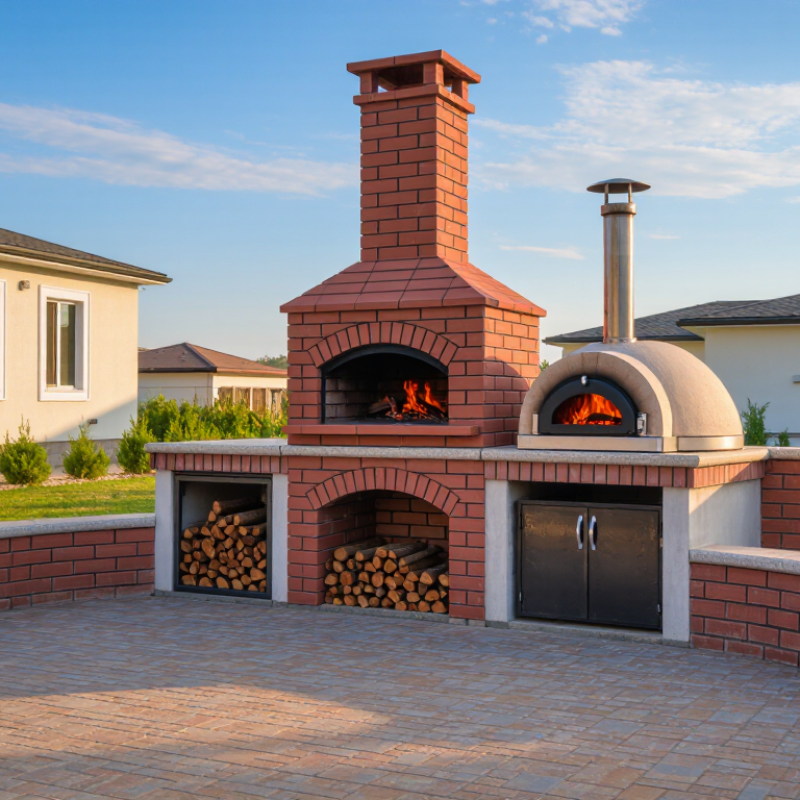
Table of Contents
[Hide]
China’s Brick Fireplace With Pizza Oven Manufacturing Landscape
China’s brick fireplace with pizza oven manufacturing landscape combines traditional masonry with modern factory controls. Suppliers commonly produce firebrick chambers, insulated domes, steel doors, ceramic flues, and weather-resistant outer shells. Production often begins with dimensional drawings, heat-load calculations, and sample material testing. Some workshops still rely heavily on manual brick placement. That can create small variations in joints and arch alignment.
Experienced manufacturers usually separate the cooking chamber from the decorative outer structure. This improves thermal stability and simplifies repairs. Firebrick density, mortar composition, insulation thickness, and chimney design deserve careful review. A practical factory should provide material specifications, curing procedures, loading tests, and installation guidance. Clear documentation matters.
Not every catalog image tells the full story. Buyers should inspect finished samples, weld quality, door seals, drainage details, and packaging protection. Export-oriented suppliers may offer modular designs for easier container loading and installation. Custom options can include wood storage, countertop extensions, regional flue fittings, and different brick colors. Yet customization sometimes increases production errors and delivery time. I would request a prototype before approving a large order.
Reliable cooperation depends on traceable inspections. Ask for batch records, moisture checks, dimensional measurements, and photographs before shipment. Independent inspection can reveal cracked bricks or weak insulation that factory photographs miss. Some suppliers communicate well during sales but respond slowly after installation. That gap deserves attention when comparing China’s top manufacturers.
China Top 10 Brick Fireplace With Pizza Oven Suppliers? – China’s Brick Fireplace With Pizza Oven Manufacturing Landscape
| Rank | Anonymous Supplier Profile | Core Product Configuration | Typical Heating Fuel | Pizza Oven Operating Range | Primary Materials | Customization Capability | Typical MOQ | Indicative Production Lead Time | Common Compliance Documentation | Best-Fit Buyer Segment |
|---|---|---|---|---|---|---|---|---|---|---|
| 1 | Supplier Profile A | Traditional masonry fireplace combined with a dome-shaped pizza oven | Wood; optional charcoal compatibility | 350–500°C | Refractory firebrick, castable refractory concrete, steel support frame, ceramic insulation | High; facade color, arch design, oven diameter, chimney position and private-label packaging | 1–5 complete units | 35–60 days | Material test reports, dimensional inspection report, export packing records | Residential outdoor kitchens, villas and landscape contractors |
| 2 | Supplier Profile B | Prefabricated brick-look fireplace with integrated single-deck pizza oven | Wood or gas-ready design | 300–450°C | Firebrick cooking floor, refractory panels, stainless-steel flue components, ceramic fiber blanket | Medium to high; modular dimensions, exterior cladding and gas-burner preparation | 5–10 units | 30–50 days | Product specification sheet, gas-component documentation where applicable, packing inspection | Retail distributors and home-improvement projects |
| 3 | Supplier Profile C | Compact brick fireplace and pizza oven module for balconies and small patios | Wood | 300–430°C | Lightweight refractory board, firebrick tiles, powder-coated steel body, mineral insulation | Medium; logo-free standard models with limited color and dimension changes | 10–20 units | 25–45 days | Load-bearing data, heat-resistance test results, carton and pallet specifications | Apartment developments, hospitality terraces and compact outdoor spaces |
| 4 | Supplier Profile D | Large commercial masonry fireplace with dual-zone pizza oven | Wood, gas or hybrid configuration | 350–500°C | High-density firebrick, refractory mortar, stainless-steel cooking surface, insulated flue liner | High; cooking chamber size, burner layout, chimney height and exterior finish | 1–3 units | 45–75 days | Commercial installation drawings, heat-load calculations, gas-system documentation where required | Restaurants, hotels, resorts and food-service contractors |
| 5 | Supplier Profile E | Arched brick fireplace with wood-fired oven and warming shelf | Wood | 320–480°C | Hand-finished firebrick, refractory concrete dome, natural stone or brick veneer, steel door | High; arch profile, veneer pattern, shelf layout and hearth dimensions | 1–5 units | 40–65 days | Refractory-material declarations, assembly drawings, pre-shipment inspection report | Custom residential construction and premium landscaping projects |
| 6 | Supplier Profile F | Flat-pack refractory oven kit with decorative brick fireplace surround | Wood; optional gas conversion provision | 300–450°C | Precast refractory segments, firebrick floor, galvanized or stainless-steel frame, insulation blanket | Medium; kit dimensions, surround finish and assembly instructions | 10–30 kits | 25–45 days | Assembly manual, component list, packaging drop-test records and material specifications | Importers, DIY retailers and regional installation networks |
| 7 | Supplier Profile G | Modern linear fireplace with side-entry pizza oven chamber | Gas or wood, depending on configuration | 280–430°C | Refractory castable lining, stainless-steel oven components, engineered stone or brick exterior | High; linear proportions, viewing window, control layout and facade materials | 3–8 units | 35–60 days | Burner documentation where applicable, installation drawings, thermal-insulation data | Contemporary residential architecture and design-led outdoor kitchens |
| 8 | Supplier Profile H | Portable or semi-portable brick-finish fireplace with compact pizza oven | Wood or charcoal | 280–420°C | Firebrick cooking plate, refractory cement, welded steel chassis, weather-resistant exterior coating | Low to medium; standard size with selectable exterior finishes and accessories | 20–50 units | 20–40 days | Product dimensions, gross-weight data, packaging specifications and heat-resistance information | Garden retailers, event caterers and seasonal outdoor-living sales |
| 9 | Supplier Profile I | Modular outdoor fireplace island with pizza oven, counter and storage base | Wood, gas or hybrid configuration | 300–480°C | Refractory brick, stainless-steel inserts, concrete board, stone or porcelain countertop | High; island length, counter material, storage modules and cooking accessories | 3–10 units | 40–70 days | Shop drawings, countertop material data, installation requirements and packaging inspection | Hospitality developments, garden-room projects and outdoor-kitchen specialists |
| 10 | Supplier Profile J | Entry-level brick-clad fireplace with insulated pizza oven insert | Wood | 280–400°C | Standard firebrick, refractory mortar, steel oven insert, calcium-silicate or ceramic insulation | Low to medium; standard configuration with limited color and accessory options | 20–100 units | 20–40 days | Basic product specifications, safety instructions, carton markings and pre-shipment inspection | Budget-focused distributors and online outdoor-cooking retailers |
Data shown are industry benchmark ranges for China-manufactured brick fireplace and pizza-oven configurations. Actual temperature, lead time, MOQ, documentation and customization terms depend on the final design, fuel system, testing requirements and order specifications.
Related Posts
-
Top 10 Benefits of Using a Pizza Oven Fireplace at Home?
-
Best Brick Oven and Fireplace for Your Home Needs?
-
What is an Outdoor Wood Fireplace with Pizza Oven Benefits?
-
Why You Need an Outdoor Fireplace Oven for Your Backyard Gatherings
-
How to Identify and Handle Element Fires Safely?
-
China Best Outdoor Fire Place Pizza Ovens for Perfect Cooking?